

You’ve probably noticed that a phone call about ants feels very different from a phone call about termites. The ant customer is annoyed, but the termite customer is terrified. One is looking for a monthly service to keep the kitchen clean; the other’s looking for a construction project to save their largest asset.
If you treat these two customers the same in your marketing, you’re burning money. Lumping “termite control” and “pest control” into the same bucket is the fastest way to dilute your message and miss out on the highest-margin jobs in the industry. But unfortunately, it’s one of the most common mistakes pest control providers make.
Let’s break down why marketing for termite control vs pest control requires two completely different playbooks and how splitting your keyword strategy will change your bottom line.
The Financial Difference: $500 vs. $2,000

A general pest control contract is a volume game. You might sign someone up for a quarterly service at $125 a pop. That’s $500 a year. It’s great recurring revenue, and it builds the base of your company value.
A termite job, however, is different. That’s a $1,500 to $2,500 ticket, often paid upfront or financed, meaning it’s a cash flow injection.
When you run Google Ads or optimize your website, you can’t bid the same amount for a $500 customer as you do for a $2,000 customer. If you have a single “Services” page that lists everything from spiders to subterranean termites, Google doesn’t know which one you prioritize.
You end up ranking for “pest control near me” which brings in a lot of low-value tire kickers, while your competitor, who built a dedicated page for “termite damage repair”, is scooping up the high-dollar leads. You need to separate these streams so you can allocate your budget where the real ROI lives.
The Psychology of the Search: Marketing for Termite Control vs Pest Control
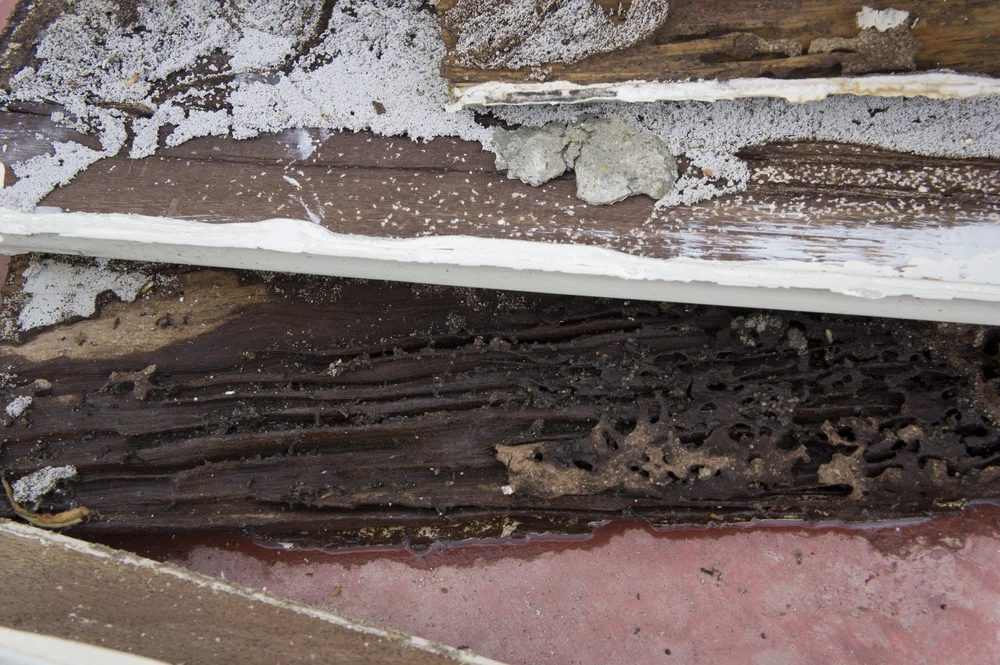
The mindset of the person searching determines the keywords they use.
The General Pest Customer (Maintenance Mindset):
This person sees a spider in the bathtub or ants on the counter. It’s gross, but it’s not an emergency. They are looking for convenience and price, and they might call three companies to compare quotes. They search for things like:
- “Pest control companies”
- “Exterminator prices”
- “Bug sprayer near me”
- “Quarterly pest service”
The Termite Customer (Urgency/Fear Mindset):
This person just found mud tubes on their foundation or swarmer wings on their windowsill. They aren’t shopping; they are panicking. They think their house is falling down, so they search for:
- “Termite inspection cost”
- “Signs of termite damage”
- “Termite treatment guarantee”
- “Sentricon vs Termidor”
As a contrast to the general pest control customer, these people are in “solution mode.” They don’t care about your quarterly special; they care about your warranty and your speed. If your website talks about “keeping bugs out,” you lost them. They need to hear “structural protection” and “damage repair.”
The Cluster Strategy: Urgent vs. Maintenance

To capture both types of customers, you need to structure your website and your content into two distinct clusters. Think of these as two separate funnels living under one roof. When you split these up, you tell Google exactly what you do. You become an authority on both topics separately, rather than a jack-of-all-trades who is master of none.
Cluster 1: General Pest (Maintenance)
Focus these pages on peace of mind, safety for pets and kids, and convenience. The keywords here should be broad.
For example:
- Keywords: Ant control, spider removal, roach extermination, quarterly pest control.
- Content Focus: “Don’t let bugs take over,” “Safe for your family,” “Keep your home clean.”
Cluster 2: Termite (Urgent/High-Ticket)
Focus these pages on expertise, technology, and guarantees. You need to sound like a structural engineer, not just a bug sprayer.
- Keywords: Termite swarmers, mud tubes on wall, termite bond, WDO inspection, real estate termite letter.
- Content Focus: “Protect your investment,” “Million-dollar repair guarantee,” “Certified inspectors.”
Why Technical Content Wins Termite Jobs
Termite customers are researchers. Because the price tag is higher, they do their homework. They want to know if you use bait stations or liquid barriers, and they want to know the difference between drywood and subterranean termites.
If your website answers these specific technical questions, you build trust before you even answer the phone.
So, don’t just write “We kill termites.” Write an article titled “Why We Use Liquid Treatment for Slab Foundations.” Explain the process of trenching and rodding. Show pictures of what termite damage actually looks like compared to water damage.
When a customer reads that, they think, “Okay, these guys know their stuff.” That trust justifies the $2,000 price tag. If you just have a generic “Pest Control” page, they’re going to wonder why you charge so much more than the guy with a backpack sprayer.
Detailed, technical content justifies the premium pricing, and perhaps just as importantly, it filters out the cheap leads and attracts the homeowners who care about quality over cost.
Don’t Let Your Ad Budget Bleed
This split strategy is important for your paid ads, too. If you run a “Smart Campaign” on Google that just targets “pest control,” you’re wasting your money.
You’ll pay for clicks from people looking for “how to get rid of fruit flies” (a $0 job) when you could have spent that money bidding on “termite treatment cost” (a $2,000 job).
You need separate campaigns.
- Campaign A: General Pest. Bid lower. Focus on volume. Offer a discount on the first service.
- Campaign B: Termite. Bid higher. Focus on urgency. Offer a free inspection.
This lets you control your acquisition cost: you might be willing to pay $100 to acquire a termite customer, but only $30 for a general pest customer. If you mix them, your math breaks, and you burn through your budget without knowing which side of the business is actually profitable.
How IronChess SEO Handles the Split
Most agencies don’t know the difference between a German roach cleanout and a preventative perimeter spray. They treat every “bug” keyword the same. That’s why their clients get a lot of traffic but not enough revenue.
At IronChess SEO, we build your digital presence, whether you’re marketing for termite control or pest control in general, to respect the difference between the $500 customer and the $2,000 customer. We create the deep, technical content that attracts high-ticket termite jobs while simultaneously building the broad local presence that fills your daily routes with general pest accounts.
We don’t just guess at keywords, either. We look at the search volume in your specific city, analyze your competitors, and build a site structure that funnels the right customer to the right page. You get the volume from general pests and the profit spikes from termite work.
Stop letting your high-margin termite leads slip through the cracks of a generic marketing strategy.
Contact IronChess SEO today and let’s build a strategy that targets the money, not just the clicks.
